

 English
 中文简体
中文简体 Español
 عربى
عربى
 Home / News / Industry News / How Do You Choose the Right Polyester Monofilament for Your Application?
Industry News
How Do You Choose the Right Polyester Monofilament for Your Application?
2026-07-22
Content
- 1 How Diameter and Denier Determine Which Applications a Monofilament Can Handle
- 2 Tensile Strength and Knot Retention: Why Smooth Surface Isn't Always an Advantage
- 3 UV Stabilization: The Difference Between Indoor-Grade and Outdoor-Grade Monofilament
- 4 Hydrophobic Properties and Drying Behavior in Marine and Outdoor Settings
- 5 Minimal Stretch and Shape Retention Under Sustained Tension
- 6 Matching Monofilament Grade to End Use: A Practical Selection Framework
How Diameter and Denier Determine Which Applications a Monofilament Can Handle
Diameter is the single most decisive spec when selecting polyester monofilament, since it directly governs tensile strength, flexibility, and how the yarn behaves under repeated flexing or knotting. Monofilament is typically measured either in millimeters of diameter or in denier, a unit representing the weight in grams of 9,000 meters of the filament — a higher denier number means a thicker, heavier strand. Fine diameters under 0.15mm are common in sewing threads and lightweight netting where flexibility and a smooth pass through machinery matter more than raw strength, while diameters above 0.5mm show up in heavier industrial cordage, agricultural fencing, or structural netting where load-bearing capacity takes priority over flexibility.
Choosing too fine a diameter for a load-bearing application leads to premature stretching or breakage under sustained tension, while oversizing diameter for a delicate application like fine embroidery thread creates stiffness that interferes with smooth machine feeding. Matching diameter to the actual working load and required flexibility, rather than defaulting to a mid-range gauge, is what prevents both under-performance and unnecessary material cost.
| Diameter Range | Typical Application |
|---|---|
| Under 0.15mm | Fine sewing thread, lightweight netting |
| 0.15mm–0.35mm | Fishing line, general textile reinforcement |
| 0.35mm–0.5mm | Decorative netting, medium-duty bags |
| Above 0.5mm | Agricultural fencing, industrial cordage, structural netting |
Tensile Strength and Knot Retention: Why Smooth Surface Isn't Always an Advantage
The smooth, continuous surface that gives polyester monofilament its abrasion resistance and clean feel also introduces a tradeoff that buyers new to the material sometimes overlook — knot retention. Because the filament's surface offers less friction than braided or twisted alternatives, knots can slip or loosen under load unless tied correctly for monofilament specifically, which is a common source of failure in fishing line and netting applications where the knot, not the filament itself, ends up being the weak point. Knots designed for braided line, such as a simple overhand knot, often underperform on monofilament and should be replaced with knots engineered for smooth, single-strand material, such as an improved clinch knot or a Palomar knot in fishing applications.
Tensile strength itself scales predictably with diameter within a given polyester grade, but the finished breaking strength at a knot is typically 10-20% lower than the filament's rated straight-line strength, a reduction commonly referred to as knot strength efficiency. Specifying breaking strength at the knot, rather than relying solely on the straight-line tensile rating printed on a spec sheet, gives a more realistic picture of how the monofilament will perform once it's actually tied, sewn, or woven into a finished product.
UV Stabilization: The Difference Between Indoor-Grade and Outdoor-Grade Monofilament
Standard polyester monofilament without UV stabilizing additives degrades measurably faster under sustained sunlight exposure than most buyers expect, losing tensile strength and becoming brittle well before the material shows obvious visual signs of wear. This matters significantly for outdoor and marine applications — landscaping netting, agricultural fencing, and marine cordage all face months or years of direct UV exposure, and unstabilized monofilament in these settings can lose a substantial share of its rated strength within a single season, creating a failure risk that isn't apparent from a quick visual inspection.
Questions worth asking before specifying monofilament for outdoor use
- Is a UV stabilizer additive included in the resin formulation, or only applied as a surface coating?
- What is the expected percentage of tensile strength retained after a defined period of accelerated UV exposure testing?
- Is the stabilizer rated for the specific climate and sun exposure level of the intended application?
Surface-applied UV coatings tend to wear off faster than additives blended directly into the resin during extrusion, so confirming which method a supplier uses is a meaningful distinction rather than a minor technical detail, particularly for applications where replacement access is difficult, such as buried landscaping netting or offshore marine rigging.
Hydrophobic Properties and Drying Behavior in Marine and Outdoor Settings
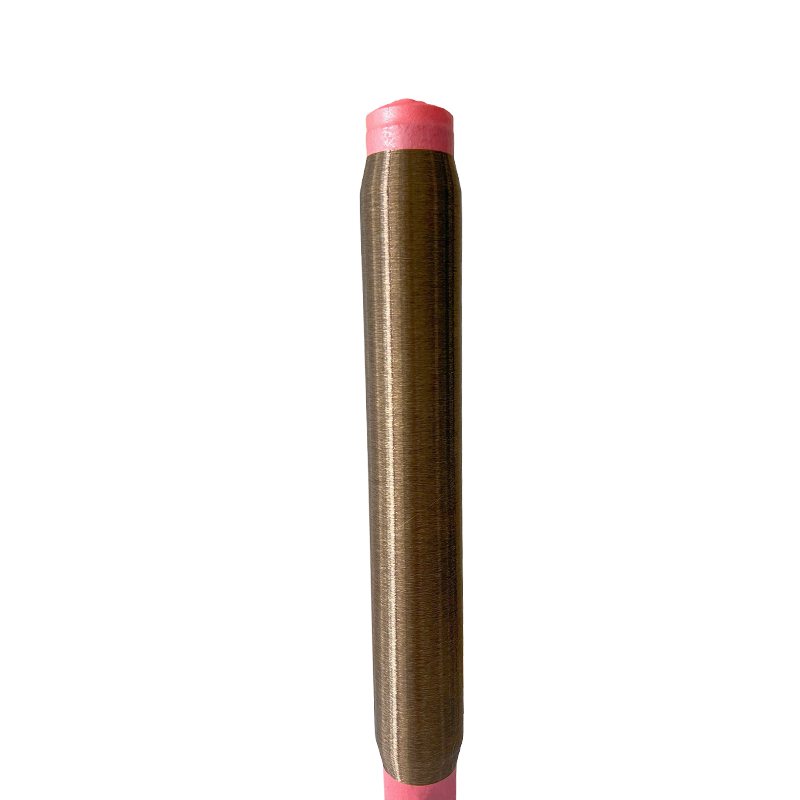
Polyester's hydrophobic nature — meaning it doesn't readily absorb water into the fiber structure — is a major reason it outperforms natural fiber alternatives like cotton or hemp in wet or marine environments. Where natural fibers absorb moisture and can weaken, rot, or develop mildew over repeated wet-dry cycles, polyester monofilament sheds water from its surface and dries quickly, retaining its strength and dimensional stability even after extended submersion or repeated exposure to rain and humidity. This property is particularly valuable in fishing line, marine netting, and outdoor textile applications where the material is expected to cycle between wet and dry conditions frequently without gradual degradation.
Mildew resistance follows directly from this same hydrophobic characteristic, since fungal growth generally requires sustained moisture retention within a material's fiber structure to take hold — a condition polyester monofilament largely avoids by not absorbing water in the first place. This makes it a more reliable long-term choice than untreated natural fibers for netting, bags, or landscaping products left outdoors through multiple seasons of rain and humidity exposure, without requiring additional mildew-resistant treatment as a workaround.
Minimal Stretch and Shape Retention Under Sustained Tension
Low elongation under load is one of polyester monofilament's more practically valuable traits, particularly compared to nylon monofilament, which stretches noticeably more under the same tension. This lower stretch matters directly in applications like sewing thread, where excessive stretch during stitching can cause puckering or inconsistent tension in the finished seam, and in structural netting, where a material that stretches under load can gradually sag or deform out of its intended shape over time. Fishing line applications benefit from this property differently — lower stretch improves sensitivity to bites and hook-set responsiveness, since energy transmitted through the line reaches the hook more directly rather than being absorbed by the line's own elasticity.
- Sewing and industrial textiles: minimal stretch reduces puckering and maintains stitch consistency
- Structural netting and bags: low elongation helps the material hold its intended shape under sustained load
- Fishing line: lower stretch improves bite sensitivity and hook-set response compared to more elastic materials
This shape-retention quality is also why polyester monofilament holds up well in decorative applications like landscaping edging or ornamental netting, where visible sagging or deformation over a season would undercut the product's intended appearance far more than a minor loss of raw strength would.
Matching Monofilament Grade to End Use: A Practical Selection Framework
Given how many variables affect performance — diameter, UV stabilization, knot strength, and stretch — selecting the right monofilament grade comes down to identifying which one or two factors matter most for the specific end use, rather than trying to maximize every spec simultaneously. A fishing line application prioritizes knot strength and low stretch over UV resistance, since most fishing line sees relatively limited continuous sun exposure compared to fixed outdoor installations. A landscaping netting or agricultural fencing application flips that priority, weighting UV stabilization and long-term tensile retention far more heavily than knot efficiency, since these products are typically installed once and left in place for one or more full growing seasons.
Industrial textile and bag-making applications tend to prioritize a middle ground — moderate diameter for machine compatibility, reliable tensile strength for load-bearing seams, and enough UV resistance to handle occasional outdoor storage without needing the heavier stabilization built into permanent outdoor installations. Working through this kind of priority list before requesting quotes helps narrow supplier options quickly, since asking for "the strongest available monofilament" without specifying the actual use case usually results in an oversized, overpriced product that doesn't match the application's real requirements.

GLOBAL BUSINESS
Backed by stable production capacity and integrated manufacturing and trading capabilities, Zhenyi Chemical Fiber is committed to serving customers in international markets. Our team provides responsive support throughout product selection, order coordination, export documentation and shipment arrangements. We aim to build long-term partnerships through consistent product quality, clear communication and dependable service.
Ready to Begin?
Categories
Contact Information

 +86-18258373586
 No. 318 Huiye Road, Fengming Subdistrict, Tongxiang, Jiaxing, Zhejiang, China.
Copyright © ZHENYI CHEMICAL FIBER All rights reserved.
